Offers
Cultivating the strength and wellness of the body
Kettlebell and Iyengar yoga in one thirty-minute flow. The bell builds strength that transfers; the yoga builds the alignment that makes the strength safe to own.
Book a 1:1 session Upcoming dates
€250 for two sessions
The West meets the East
Each one covers the other's gap
Most strength training leaves you stiff. Most yoga leaves you mobile but weak through range. Put them in the same session, alternating, and each one covers the other's gap — this is the peak of the synergy between them, cultivating strength and flexibility in the same movement.
It is built for people with jobs: professionals and students who do not have ninety minutes plus travel. Thirty minutes, at home, with one piece of equipment. Better than a gym for this purpose, because the aim is functional strength from simple gear — and because what we are really building is perseverance and quiet strength.
Thirty minutes, alternating
The bell and the pose are not two halves of a session. They interleave, so that each one prepares the body for the next.
Kettlebell, 17 min Iyengar yoga, 13 min
-
00–04
Tadasana and breath
Set the reference every standing pose is measured against.
-
04–10
Swings
The hinge, loaded. Hips do the work; the arms only carry.
-
10–14
Trikonasana, Virabhadrasana II
Open the shoulder and hip the press will need.
-
14–20
Clean and press
Overhead strength, earned through a stable ribcage.
-
20–24
Supta Virasana
Undo the front-body shortening the press just created.
-
24–29
Turkish get-up
Seven positions, one bell, no hurry. The whole body at once.
-
29–30
Savasana
Short, and not optional.
One bell is enough. If you are buying your first, 12 kg suits most people new to this; 16 kg if you already lift.
Kettlebell training
Functional strength from one simple object
Swings, cleans, presses and get-ups. No machines, no isolation work, and nothing that only makes you stronger at the machine itself. What the bell trains is the hinge, the overhead position and the ability to stay organised under load — three things that transfer to carrying, lifting and standing up for the rest of your life.
Kettlebell-like training is not a modern invention, and it was not invented once. Nearly every martial culture arrived at the same answer independently: a heavy object with a handle, swung.
Four cultures, one answer
-
Ancient Greece
from the 6th century BCE
Halteres, swung to extend the long jump — and the stone of Bybon at Olympia, 143 kg, with a handle cut straight into it.
-
China and Okinawa
imperial era onward
Stone locks and chiishi, swung to build the grip and shoulder integrity that armed combat demanded.
-
Persia
the zurkhaneh tradition
Meels — heavy wooden clubs swung in rhythm, in a sunken pit, to a drum. Strength kept as a discipline, not a display.
-
Russia
from the 1700s
The girya, a cast-iron market counterweight that became a sport the moment somebody started throwing it around.
Iyengar yoga
Alignment, held long enough to be corrected
The yoga I teach is Iyengar yoga, so what you are getting is kettlebell work combined specifically with that method — not with a generic flow class.
The distinction matters here more than anywhere else, because Iyengar yoga is obsessive about one thing: precision of alignment, held long enough to be felt and corrected. That obsession is exactly what a loaded swing needs. A kettlebell exposes every compensation you have — a shoulder that shrugs, a lumbar spine that takes the load the hips refused. Iyengar practice is the diagnostic that finds those compensations, and the discipline that undoes them.
What it brings
Three things no other method brings as reliably
-
Alignment as the first principle
Where the foot points, where the knee tracks, what the shoulder blade does. These are not refinements to add later; they are the pose.
-
Timed holds
Staying in Trikonasana long enough for the initial effort to pass and the actual structure of the pose to appear. This is where endurance in the small stabilising muscles is built.
-
Props, used without embarrassment
A block or a belt lets you hold the correct shape today, instead of practising the wrong shape for a year while waiting to become flexible enough.
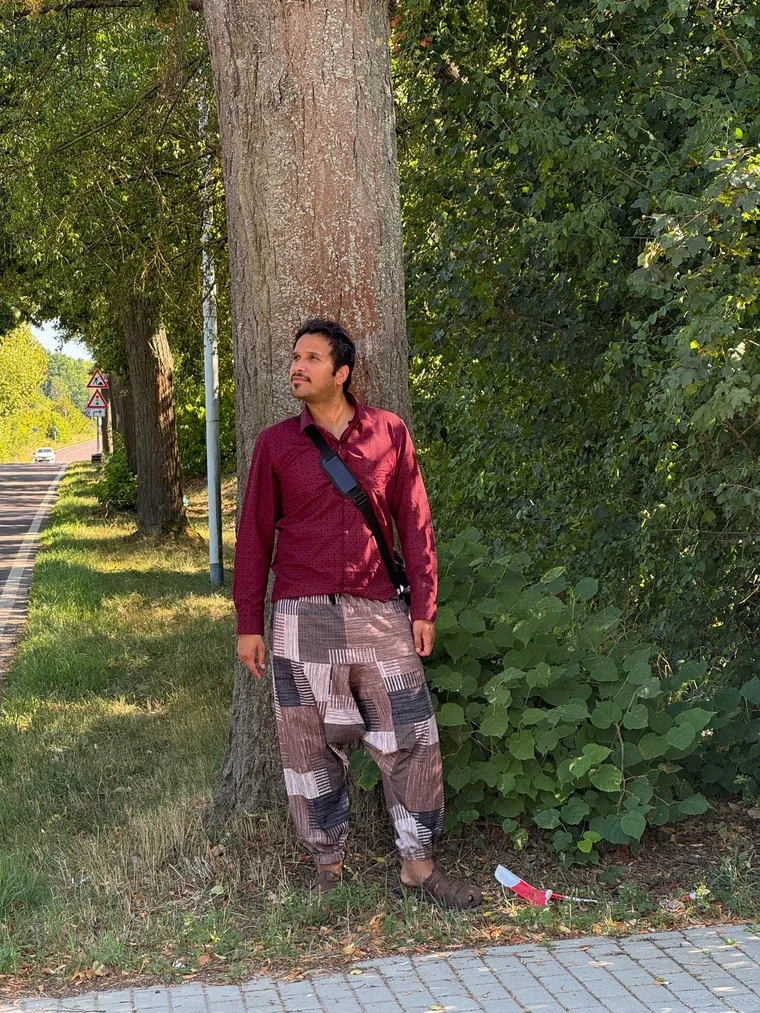
If you cannot reach your toes
Then you are exactly the person this was designed for.
Nothing here requires you to arrive flexible, and nothing requires you to arrive strong. The first session is spent finding out where your body actually is, and the flow is built from there. Stiffness is a starting condition, not a disqualification.
Book a 1:1 session
Sixty minutes, online. Tell me what you already do and what hurts, and I will build the first flow around that.
Sessions run online. Prem replies personally, usually within two days.
Not ready to book? The free guide gives you the flow to try on your own first.
Download the free guide